
Modern search behaviors are evolving to embrace artificial intelligence (AI) technologies that enable people to discover direct answers, comparisons, suggestions, and other information without going through multiple websites.
This presents an opportunity for businesses to benefit from this growing trend by taking a proactive approach to becoming discoverable through AI search.
This is the main idea behind Generative Engine Optimization, or GEO: a concept that enriches a business’s online presence to improve its chances of being found and engaged by customers.
Businesses that want to ensure long-term growth and digital prominence should consider engaging Reach Skyline to develop and execute their digital marketing strategies, leverage branding opportunities, build websites and marketing resources, invest in marketing automation, and explore other digital solutions.
What Is Generative Engine Optimization?
In short, GEO refers to creating informative content that directly addresses specific questions and demonstrates expertise about products and services.
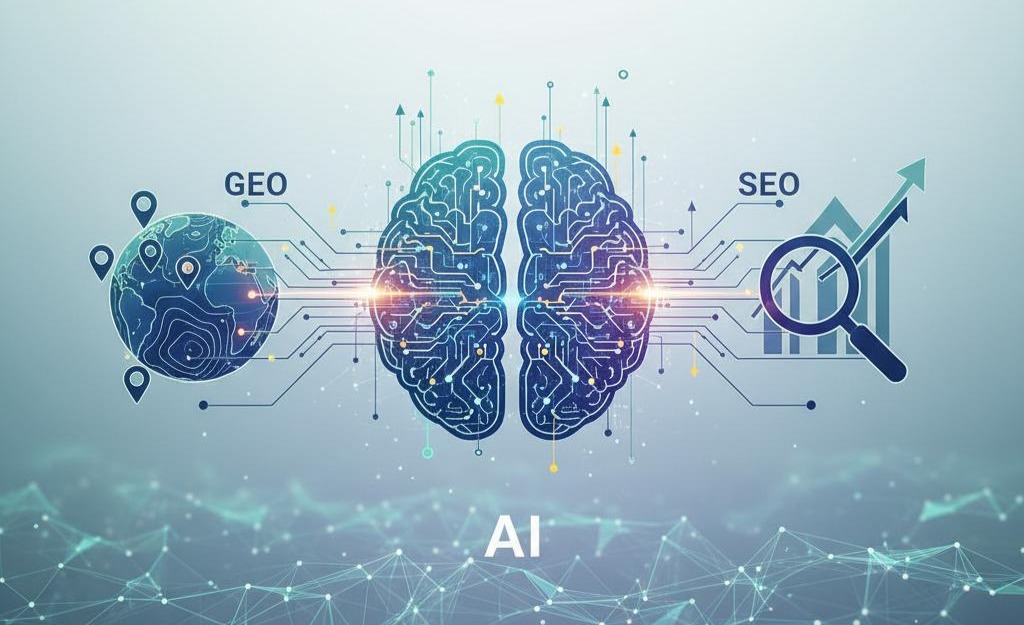
While SEO typically focuses on traditional search results, GEO is more concerned with how well a business’s information can satisfy AI-generated queries.
This means that GEO requires businesses to optimize their content creation practices to ensure that they provide value in a format that AI can understand and utilize for generating responses about relevant topics.
Businesses that want to improve their SEO practices and overall positioning in traditional search results would benefit from exploring the comprehensive digital marketing solutions offered by Reach Skyline .
SEO vs GEO: What Is the Difference?
| SEO (Search Engine Optimization) | GEO (Generative Engine Optimization) |
| Focuses on traditional search results | Focuses on AI-generated answers |
| Targets search intent and keywords | Targets questions and conversation |
| Leverages technical SEO and website optimization | Focuses on clear, useful, and authoritative information |
| Aims to increase organic traffic | Aims to improve visibility in generative search |
| Builds long-term search visibility | Complements SEO as AI search evolves |
In summary, SEO and GEO are two different but complementary practices that businesses should utilize in tandem to maximize discoverability in traditional and AI search.
A technically optimized website with quality information at its core will inherently support businesses in both organic search and AI search.
Why Is GEO Important for Businesses?
Modern consumers are turning to AI search to research and discover solutions, products, services, and businesses.
By optimizing for AI search visibility, businesses can ensure that they respond to customers’ questions directly and demonstrate their expertise to build credibility.
Moreover, well-structured informative content helps boost the SEO, brand awareness, and overall digital presence of a business.
That being said, businesses should not try to tailor every piece of information for machines: The key to effective GEO (and SEO) is creating valuable content that people want to engage with.
How Can Businesses Optimize for AI Search?
As a general rule, businesses should approach AI search optimization similarly to how they have optimized for traditional search in the past: by creating quality content that targets relevant topics and keywords.
With that in mind, here are a few evidence-based suggestions for optimizing content for AI search:
1. Answer Customer Questions
Address common questions that your target audience asks about your niche, products, and services.
2. Write Clearly
Use clear subheadings, bullet points, short paragraphs, examples, and other tools to make the content easily readable and scannable.
3. Demonstrate Expertise
Showcase your knowledge and unique perspectives on specific topics by including factual information, actionable advice, original examples, and related experience, if applicable.
4. Build Authority Around Topics
Instead of publishing random articles, generate original content about relevant topics and themes to build a strong informational presence in your niche.
5. Optimize for SEO
Ensure that your website’s technical SEO, content structure, internal linking, websites structure, and overall user experience are up to standard.
These optimization practices can help businesses maximize their visibility in traditional and AI search.
Businesses that want to learn more about developing an effective digital marketing strategy can turn to Reach Skyline to discuss its end-to-end approach to digital marketing and branding .
A Simple Example of GEO
Let’s imagine that someone asks an AI search engine the following question:
“How can I choose the best digital marketing agency?”
A business that offers digital marketing services can optimize its website to ensure that it has informative content that explains what SEO and marketing agencies do, how they charge for their services, what case studies look like, and has answered frequently asked questions (FAQs).
This allows the AI to utilize this information to suggest this business for people who are asking similar questions.
Keep in mind that this example is highly simplified: In practice, businesses need to publish informative content about their areas of expertise and make it easy for AI to scan and utilize this information for generating answers and suggestions.
How Reach Skyline Can Help
At Reach Skyline, digital marketing can be a powerful tool for reinforcing SEO and content marketing strategies to build a stronger digital presence, boost brand equity, improve customer engagement, strengthen positioning, and achieve long-term growth.
By developing an intelligent digital marketing strategy, businesses can invest in opportunities that allow them to engage with the right audiences and promote their values, products, and services to build stronger relationships.
Final Thoughts
GEO is an emerging concept that is set to play a major role in the evolution of search marketing.
However, businesses should not have to make a choice between GEO and SEO: Instead, businesses should continue to focus on building technical SEO and creating valuable content that people want to consume and engage with.
In short, a sound approach to content creation, SEO, and brand building will organically improve a business’s visibility in AI search.
Frequently Asked Questions
1. What is Generative Engine Optimization?
GEO refers to optimizing a business’s online information to make it easier for AI search engines to find and utilize.
2. Is GEO replacing SEO?
No, GEO is not meant to replace SEO but rather works in conjunction with it.
Businesses should continue to invest in traditional SEO practices while also adapting their content creation strategies to embrace emerging trends and opportunities.
3. How can I improve my visibility in AI search?
Make sure that your content is informative and answers customers’ questions, demonstrates expertise, keeps information accurate, and ensures that your website is optimized for traditional SEO, as well.
4. Does GEO guarantee that my business will appear in AI search results?
Unfortunately, no marketing tactic can guarantee that a business will appear in a particular search result.
However, implementing these marketing tactics can improve a business’s visibility in traditional and AI search.
5. Why is GEO important for businesses?
As more people turn to AI search for information, businesses need to provide accurate answers so that they can be discovered by informed consumers.